


Demand scales. Your team doesn't.
Every new customer, every new distributor, every new product line expansion adds to the inbound technical question load. Hiring FAEs is slow, expensive, and linear. The demand curve is not.
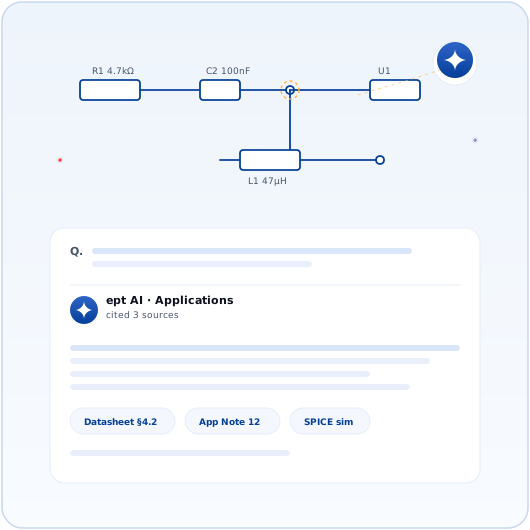
Every OEM supplier reaches the same ceiling: FAE bandwidth. Demand for technical depth scales with your customer base; your team doesn't. AI Applications Engineer handles the first layer — across internal chat, customer ticketing, and programmatic workflows — so your experts focus on the problems only they can solve.
One Semiconductor FAE Director said it directly: my biggest challenge is not having enough FAEs. Every OEM supplier says some version of the same thing.
Every new customer, every new distributor, every new product line expansion adds to the inbound technical question load. Hiring FAEs is slow, expensive, and linear. The demand curve is not.
Specs, compatibility, application fit, documentation lookups — most inbound technical questions have known answers. Every hour a senior FAE spends on these is an hour not spent on complex design-in support or new account development.
Your support team handles inbound technical requests through a ticketing system. The answers exist in your documentation and application notes. The gap between question and answer is a human bottleneck.
Built on all of your product data plus customer interactions, built to serve your internal teams and support workflows. Every answer is grounded in your actual documentation and profile data — specific, citable, and trustworthy.
Reps, junior FAEs, and application engineers get cited, source-linked answers for specification lookups, compatibility checks, and application fit questions — in seconds. A rep asks about the max ambient temperature for a part in a sealed enclosure and gets a cited answer, not an email to a senior FAE.
Anyone can put an LLM on a PDF. These are the things that actually separate a virtual applications engineer from a search box with personality.
Living Profiles are curated and continuously updated — not a one-time crawl of your documentation. When specs change, answers change. When gaps are found, they surface for resolution.
New datasheets, updated app notes, revised specs — ingested, structured, and live without manual intervention. Your knowledge base stays current without a content team maintaining it.
Doesn't rely on a single vector search pass. The system reasons across multiple sources, follows reference chains, and assembles answers the way a senior FAE would — not just returning the closest paragraph to the query.
Responses cite the source document — datasheet, app note, compatibility matrix. Not because it sounds credible, but because your customers and your team need to trust it.
Not trained on general technical content. Structured around how semiconductor and industrial component questions actually work — parametric constraints, application fit, design tradeoffs.
Novel application, edge case, ambiguous spec — AI Applications Engineer routes to the right human with context already assembled. Most chatbots hallucinate. This one defers.
AI Performance Management runs 100+ automated checks per answer. AI evaluations test grounding, technical accuracy, and component-specific reasoning continuously — against domain criteria, not generic LLM benchmarks.
Not a standalone tool. Every interaction feeds Living Profiles, surfaces signals for Deal Room and Application Room, and improves answers for every future inquiry across all three surfaces.
AI Applications Engineer serves different roles through the same intelligence layer — grounded in your Product, Application, and Customer Living Profiles.
The most convincing demo is a live Q&A on your own catalog. Every pilot starts with your product documentation loaded into Living Profiles. The answers are specific to your products from day one.


