
Your products fit more markets than you're currently selling into. The challenge isn't product fit — it's that understanding where the fit is, who the buyers are, and whether a vertical is worth pursuing requires research that's slow, time-consuming, with external dependencies and almost always out of date by the time a decision gets made.
Market size estimates live in expensive analyst reports. Competitive landscape mapping means hours of web searches and reading conference programs. The ecosystem of customers, partners, standards bodies, and competitors is scattered across trade publications, LinkedIn, and the heads of the three people on the team who've worked that space and in your desired GEO before.
The result is a static snapshot that gets distributed across the company in PowerPoint. Roadmap and GTM decisions made on incomplete information, with months of latency between the market signal and the response.
Some teams try to close this gap with generic AI tools — asking ChatGPT to summarize a market or build a competitor list. That gets you part of the way because it doesn't connect the market picture with your specific product portfolio. It doesn't internalize your catalog, your existing customers, or where your products have historically won. The output is generic because the input is generic.
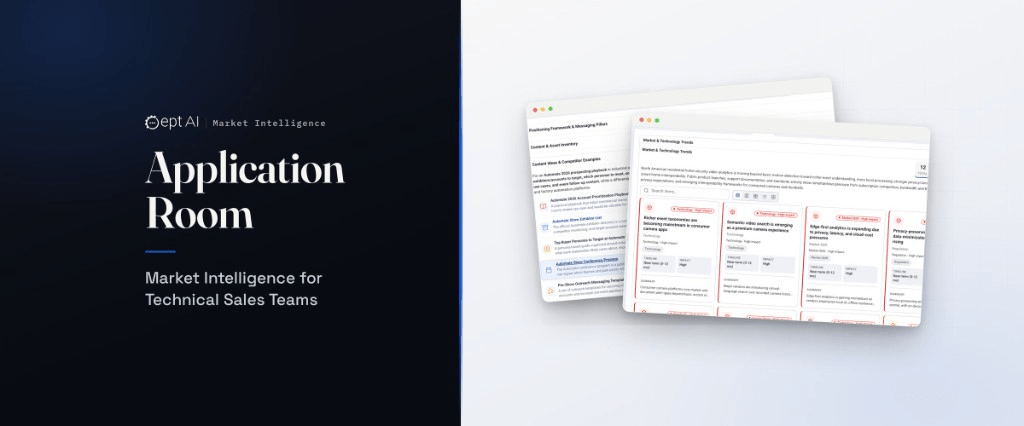
Application Room is different because it's built on your product knowledge. It understands your catalog — your datasheets, application notes, technical requirements — and uses that context to map an application area in a way that's specific to your company's position in it, not a generic overview any competitor could pull. We do that work for you, and we can do it for multiple segments concurrently so your team isn't starting from scratch every time a new market comes into scope.
Application Room is built on your product knowledge—it maps an application area in a way that's specific to your company's position in it, not a generic overview any competitor could pull.
Who It's For
Application Room serves the commercial team members responsible for identifying and entering markets — before individual deals are being worked.
Product Managers, Product & Applications Marketing and Business Development who own market analysis and entry decisions and are responsible for translating market intelligence into roadmap direction and field-usable positioning.
Sales teams — use it to ground outreach in the customer's actual technical environment and to walk into industry events prepared. Rather than generic messaging, they enter conversations knowing the companies in the space, what's driving their buying decisions, and where the natural product fit is.
What It Does
Application Room is a market and ecosystem intelligence workspace. A user describes a target application, vertical, or use case and Application Room assembles a structured picture of that space:
- Market trends, sizing and segmentation — addressable market, growth vectors, dominant application areas.
- Ecosystem mapping — Tier 1 OEMs, emerging challengers, systems integrators, standards bodies, and the relationships between them
- Competitive landscape — how competitors are positioned relative to your portfolio, where you have natural advantages, where the gaps are
- Technical requirements — what buyers in this market actually need: performance specs, certifications, form factors, integration dependencies.
In yesterday's world, an analyst report from six months ago might have been adequate. In today's accelerated global market, it won't reflect what's happening right now — or in your specific geography. Application Room stays current as the competitive landscape and ecosystem evolve — so when an expansion conversation comes up, it's grounded in what the market looks like today, not last quarter.
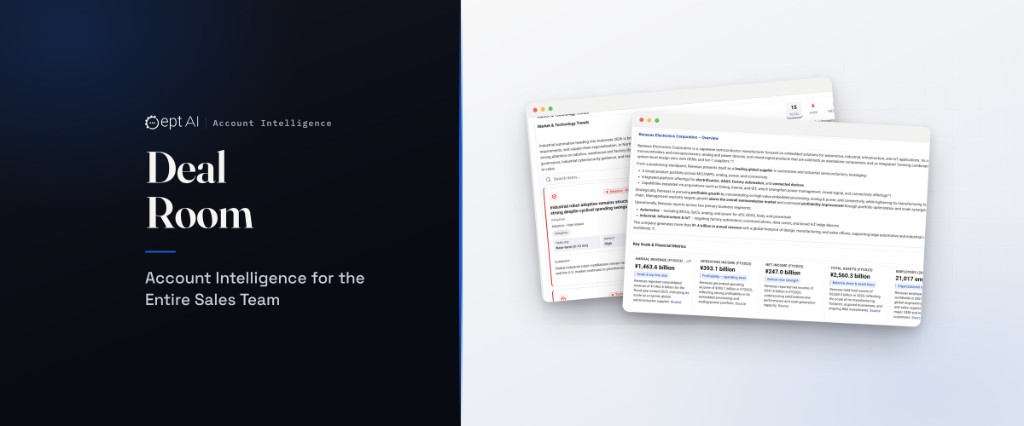
From within an Application Room, a user can identify a target company and generate a deal workspace in a single action — carrying the application context directly into the account pursuit. Because Application Room understands the application landscape, it can also surface adjacent markets and use cases where your portfolio has a natural fit you hadn't considered — expanding the opportunity picture beyond the vertical you started with.
Where It Fits in the Sales Motion
Application Room operates at the top of the funnel — but not in the sense of marketing lead generation. It's the intelligence layer that determines which markets and accounts should enter the funnel at all.
Before the funnel: A team is evaluating whether to pursue a vertical or application area. Application Room is how they make that decision with data rather than intuition — mapping the opportunity, identifying the players, and surfacing the technical fit before any development or selling effort is committed. This is where the generic AI gap is most acute: a tool that doesn't know your products can tell you the market exists, but it can't tell you whether you have a credible position in it.
At funnel entry: Once the decision to pursue is made, Application Room feeds account selection. Rather than building from a generic company list, the team identifies prospects who fit the specific ecosystem picture the Application Room has assembled — with the right product lines and entry angles already mapped.
Deal initiation: From within an Application Room, a user can identify a specific prospect and generate a deal workspace in a single action, carrying the application context directly into the account pursuit. The rep doesn't start from scratch — they start with the market intelligence already in place.
We build your demo from your own product catalog and target application — so you see exactly how Application Room would work for your team before you commit to anything. Usually 30 minutes. Request a demo.