
Your sales team is covering a lot of accounts. There's no way to give all of them the time it takes to really understand them — the stakeholders, the competitive threats, which product lines fit the customer's architecture, what's happened in every prior conversation. Some accounts get that attention. Others have enough history that the team assumes it's not needed. Most get whatever the rep can piece together beforehand. It's a capacity problem.
CRMs capture what happened. They don't tell you what matters next. They log the contacts you already know — not the stakeholders you're missing. And they don't understand semiconductors or hardware — they can't reason about product fit, application architectures, or which business unit to lead with in a given account. That's not a knock on CRM. It's what CRM was built to do.
Generic AI tools don't solve it either. They know nothing about your products, your deals, or your customers. A Copilot or ChatGPT license can make someone more productive in a general sense. It can't tell a rep which product line to lead with in a specific account, surface a cross-sell opportunity across business units, or generate a pre-call plan grounded in the actual history of that relationship.
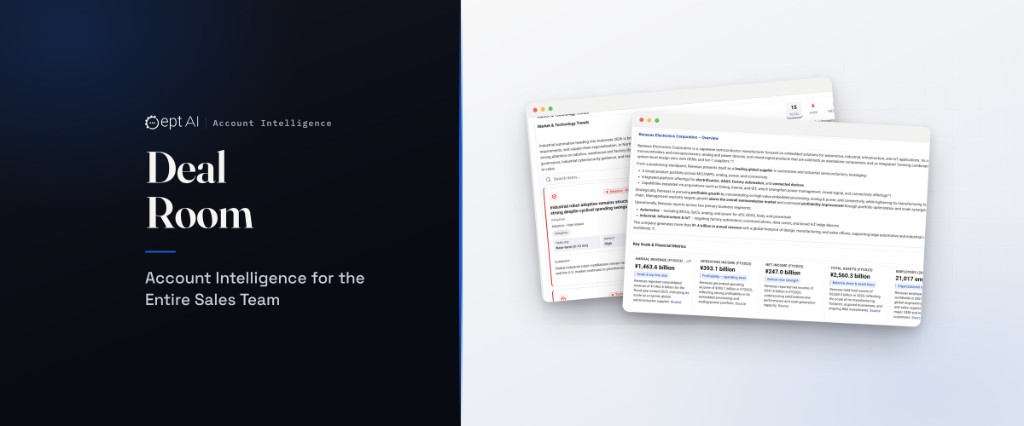
Deal Room is built for that specific problem — and it works with your CRM, not around it.
CRMs capture what happened. They don't tell you what matters next.
What It Does
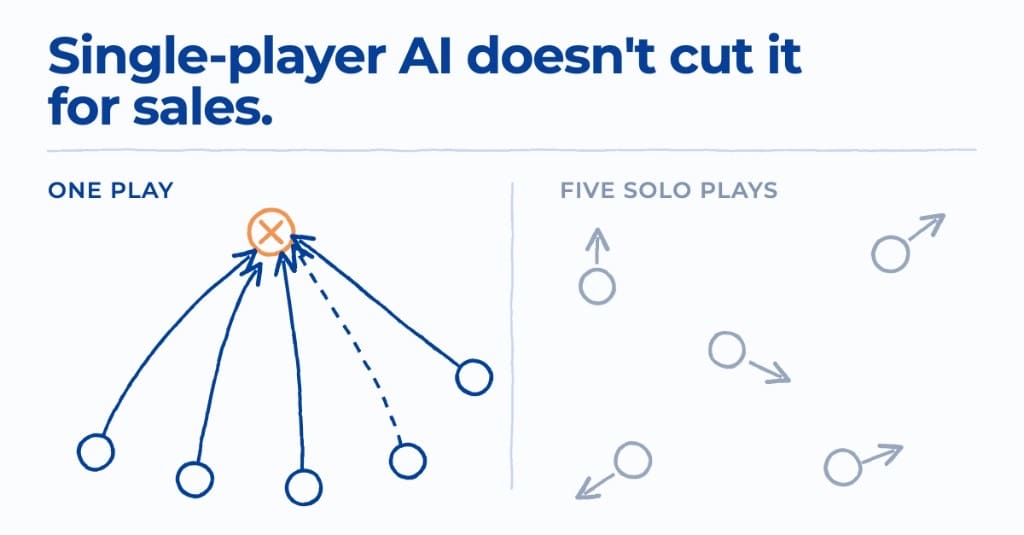
Deal Room is a persistent workspace organized around a single deal — its own stakeholder map, its own intelligence thread, pulling from CRM records, email threads, and meeting transcripts, updated continuously as new information comes in. It stays live and is shared across everyone working the deal.
Before every meeting, it generates a pre-call plan in minutes: named stakeholder hot buttons, competitive risks specific to this deal, product angles grounded in what's actually happened so far. One sales leader described the ask directly — pre-call planning summaries generated automatically, saving significant prep time. That's not a feature request. That's a real cost being measured.
Because it understands hardware, it can do things CRM never could. Pre-built battlecards comparing your product vs the competition. Application architectures that map where your products fit. Cross-sell signals that surface not just the lines the rep knows, but adjacent lines they might not pitch — a recently acquired product family, perhaps. In one case, a team used it to identify three relevant product lines for an account that had gone quiet. The customer responded to all three. That email became a team template.
When a rep leaves, the Deal Room stays whole. Every insight accumulated over the life of the deal is there for whoever picks it up next.
Who It's For
Deal Room is built for semiconductor and hardware sales cycles — long timelines, multiple stakeholders, deep product portfolios, design-win-centric pipelines. The buyers are VP Sales, Head of Sales, and CRO — the people accountable for revenue per headcount. The ept AI platform addresses technical depth and market intelligence through other products. Deal Room is the account intelligence layer for the reps running deals.
The underlying problem is structural. Most deal intelligence lives in the heads of the people who built the relationships. What changes when that intelligence becomes a shared, current workspace — accessible to every rep, every time — is not just one deal. It's what your whole team can carry into every meeting.
We build your demo from your own product catalog and accounts — so you see exactly how Deal Room would work for your team before you commit to anything. Usually 30 minutes. Request a demo.