
I joined a smart-metering company to run engineering, then took over sales and marketing. That was my first exposure to true Enterprise Sales: large deals ($1M+), large buying committees (up to dozens of stakeholders), and long cycles (12+ months was typical). Having a great product was important in these deals, but sales played a big role in the deal too: the customers (electric utilities in this case) were making a big bet on a supplier. Not only could a bad decision have a big negative impact on the company, but the individual stakeholders were often risking their careers on the decision. The decisions these utilities made were rooted in hard, measurable facts, but the final decision was a decision of people. A decision of confidence that the people had the capability and the commitment to deliver success.
In the age of AI this does not change one bit.
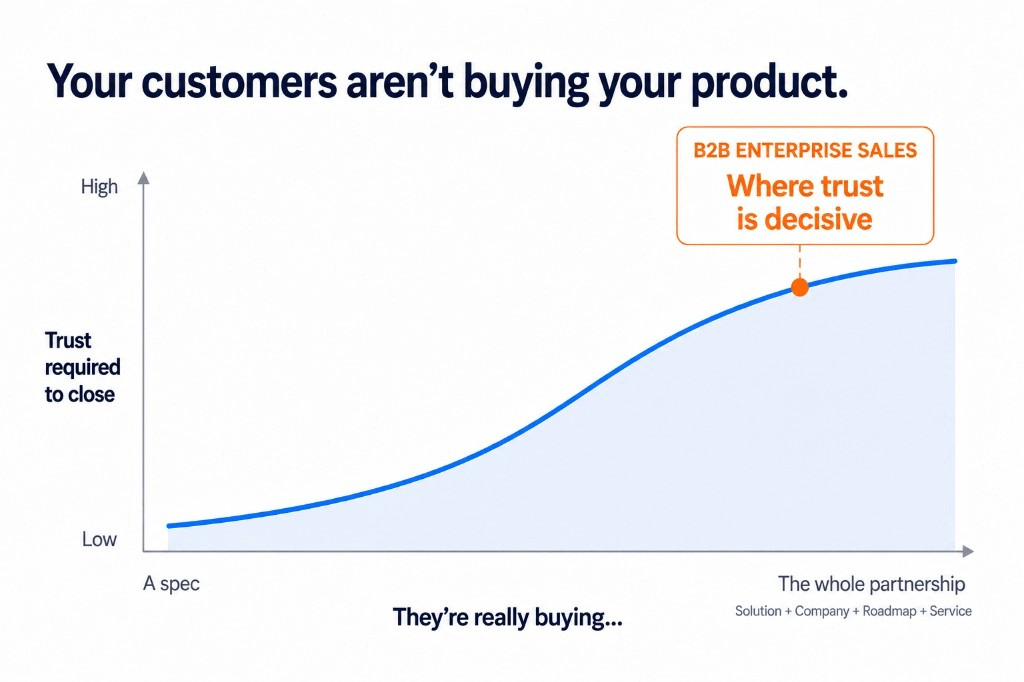
In my last post I talked about Credence Goods - products where the value of a deal is difficult to determine at the decision time. The perceived value is dependent on trust: trust of the company to deliver, trust that the unspecified or unmeasurable capabilities exist in the company and the product, trust that the product quality is high (even on things that are difficult to verify), trust that the company roadmap will continue to evolve in the right direction, and trust that the company will be a reliable supplier and partner. This is typical of Enterprise Sales - both large enterprise-software deals and most OEM sales. Enterprise Sales are built on trust.
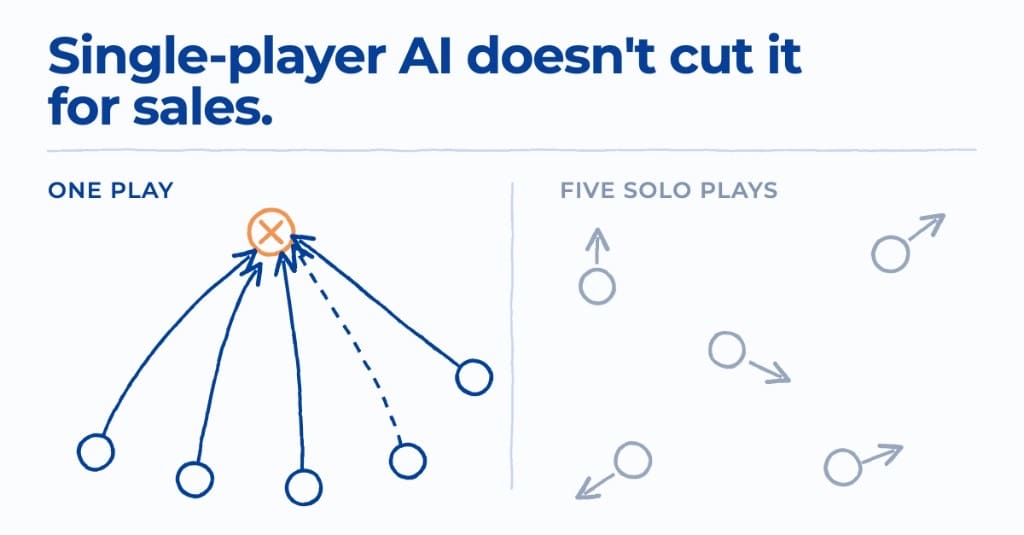
You wouldn't know that looking at most AI sales startups. They often imply that sales success is determined by email volume and accurately reading online intent signals. And for the transactional end of the spectrum they're right: for high-velocity, lower-value deals, an AI that knows the product cold and answers instantly will often beat the average rep, and a lot of what buyers call "distrust" of AI there is really just unfamiliarity that will fade. But Enterprise Sales requires a different level of trust. Trust that an AI assistant or auto-generated email will not deliver.
We can bucket sales into product-led growth (PLG) and Enterprise Sales, or sales-led growth (SLG), and later we'll see how the impact of AI will be very different in those two models.
PLG is typically lower value, fast-closing deals, often with self-service signup and close. Slack is the classic example of getting started with a PLG GTM approach. A lot of the SaaS boom over the past decade has been PLG companies selling to other startups then expanding to more small and medium-sized customers. As PLG companies mature they sometimes move up to Enterprise Sales as they sell larger deals to larger customers.
Enterprise Sales or SLG is typically the higher value ($100k+), longer-cycle deals (often 12 months or more). Enterprise software companies like Salesforce, industrial OEMs like semiconductor companies, investment banks, consultants all fit in the Enterprise Sales category. This is less common in the SaaS startup world because Enterprise Sales requires more senior salespeople and the velocity isn't as high, so it doesn't automatically favor fast-moving startups.
The focus of the GTM for each of these is quite different. Below is a comparison.
| Product-led growth (PLG) | Enterprise Sales / Sales-led growth (SLG) | |
|---|---|---|
| Prospecting and Discovery | Product does the prospecting. Inbound signup, self-serve trial, freemium usage - the "prospect" finds you because the product's value is legible enough to try without a conversation. | Company must actively identify and pursue targets. Because the buyer can't self-qualify from a website, someone has to go find the accounts where the problem is real and start earning attention before any product is touched. |
| Qualifying | Behavioral/usage-based. Product analytics (seat count, feature adoption, usage frequency) substitute for a qualifying conversation - the data tells you if this account is worth pursuing. | Conversation-based, often multi-threaded. Because the value is unverifiable up front, qualifying means assessing the buyer's problem, budget, and internal alignment - and assessing whether they trust you enough to keep talking. |
| Closing | Self-service or lightweight sales-assist. Low price point and low perceived risk mean the buyer can decide alone - a credit card, not a committee. | Requires demonstrated trust: references, pilots, executive alignment, sometimes a champion who vouches for you internally. The close isn't a decision about the product - it's a decision about the supplier. |
| Deployment | Self-serve activation. In-product guidance, tooltips, and time-to-value emails carry the user to their first win - the product onboards itself, because if it needed a human to work, it wouldn't be PLG. | The moment of decision and the moment of proof are different moments, often separated by months. In enterprise software it's implementation and rollout; in OEM sales it's the ramp from design win to production. The buyer committed on incomplete information, and now reality either confirms the leap of faith or quietly erodes it - which is why a person has to shepherd it, not a workflow. |
| Expanding | Product-led expansion: usage triggers upsell (more seats, higher tier) with minimal human involvement. | Relationship-led expansion: account teams, executive sponsors, and a track record of delivery convert a pilot into a platform relationship - trust compounds instead of usage compounding. |
There is a lot of innovation in AI for PLG companies - the VC-funded companies serving the VC-funded AI SaaS companies, and it's a crowded space with lots of companies doing similar things. But AI for Enterprise Sales? That's a totally different animal, with a totally different set of requirements.
The hard problem in AI for sales is: how can we use AI to increase trust in Enterprise Sales?
Stay tuned for thoughts on where and how AI is building trust in Enterprise Sales.
The hard problem in AI for sales is: how can we use AI to increase trust in Enterprise Sales?