
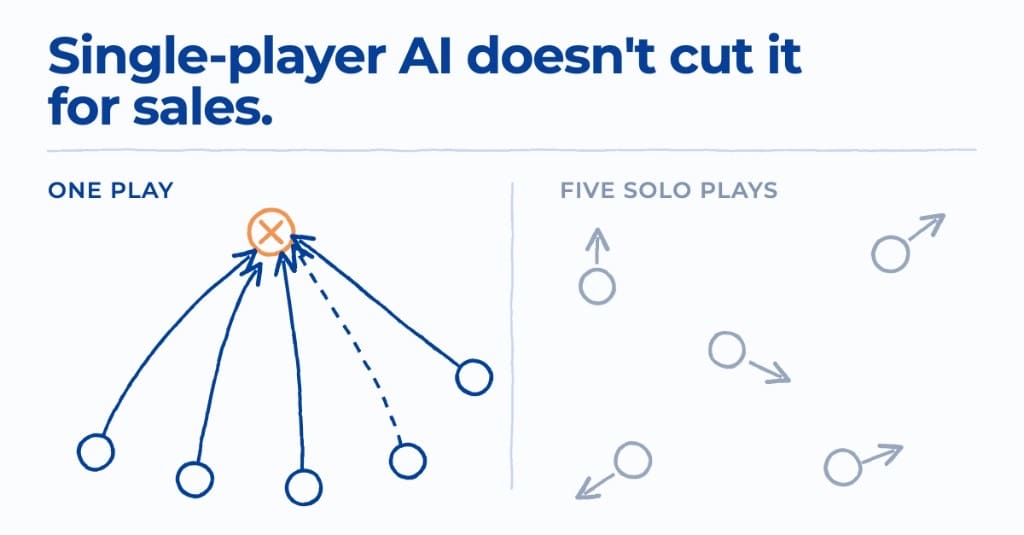
Enterprise sales is a multi-player game. Most AI is single-player.
A typical deal in the semiconductor industry pulls in one or more applications engineers, a regional sales leader, maybe a global account manager, and an applications marketing specialist. Gartner puts the average B2B buying group at 11 active members, each with their own perspective and their own ability to say no. A healthy deal means engineers talking to engineers, procurement working with sales and operations, execs aligning with product leaders. Everyone has a role, and like any good team, the ones who play together well are the ones who win.
But most companies are rolling out AI as if enterprise sales were a single-player sport.
Enterprise sales is a multi-player game. Most AI is single-player.
Generic chat tools don't move the needle
They deploy Copilot, ChatGPT, or Claude across the org, and then wonder why productivity and win rate barely move. Each rep, each marketer, each applications engineer works their own slice of the problem with their own AI — an AI with no idea who else is on the deal, what the account's history is, or what the rest of the team already knows. It's not a surprise this doesn't move the needle: MIT's State of AI in Business 2025 report found that 95% of enterprise generative AI pilots deliver little to no measurable P&L impact, and the pattern shows up worst in workflows like sales that are inherently collaborative rather than solo.
The root cause is architectural. Chat interfaces are built single-player by design: one person types, one person reads the answer, and at best they forward the output to a teammate. At worst, that one person's thinking drifts in its own direction, quietly diverging from the rest of the team without anyone noticing. That's the opposite of how strong sales teams actually function, where a stakeholder map, an objection that came up on a call, or a competitive data point needs to reach five people, not stay with the one person who asked the question.
The cost of five solo plays
The cost shows up in familiar ways:
- the same research gets redone by three different people on the same account.
- Messaging drifts between the AE and the applications engineer because they're each getting a different answer from their own chat window.
- A cross-sell sitting in plain sight in another region or business unit never surfaces, because no system connects the two reps who'd need to see it together.
And this is not just theoretical — one McKinsey case study of a global industrials company found that once a shared research and intelligence layer was fully rolled out to the sales team, conversion rates rose 40% and lead execution sped up 30% — a result that came specifically from giving the whole team the same intelligence, not from individual productivity gains.
What multi-player AI actually looks like
A few markers, based on where the more sophisticated teams are already heading:
- Shared Context. Context is aggregated at the account and deal, person, and application level, not in a private chat history. Anyone new to the deal inherits what's already known instead of starting from zero.
- Constantly Evolving. Every touchpoint — a call, an email thread, a CRM update, a piece of public news — enriches the shared context.
- Automatic Connections. The system actively makes connections a human wouldn't have time to find: a rep in one region working the same application as a rep in another, an expansion opportunity implied by usage data sitting in a different business unit.
- Multi Player. Collaboration is the default behavior, not a manual "share" button bolted onto an individually-oriented tool.
None of this is exotic — it's closer to how the best account teams already operate without AI. The tools that get this right don't look like a better chatbot. They look more like infrastructure for how teams already think about strategic accounts: shared, cumulative, and built for teams with multiple roles.
Enterprise AI's real unlock in sales isn't a smarter model. It's making the AI a teammate the whole deal team is playing with — not five people quietly playing five separate games.